Content Warning: The book reviewed here contains references to self-harm, suicide, death, animal death, and addiction.
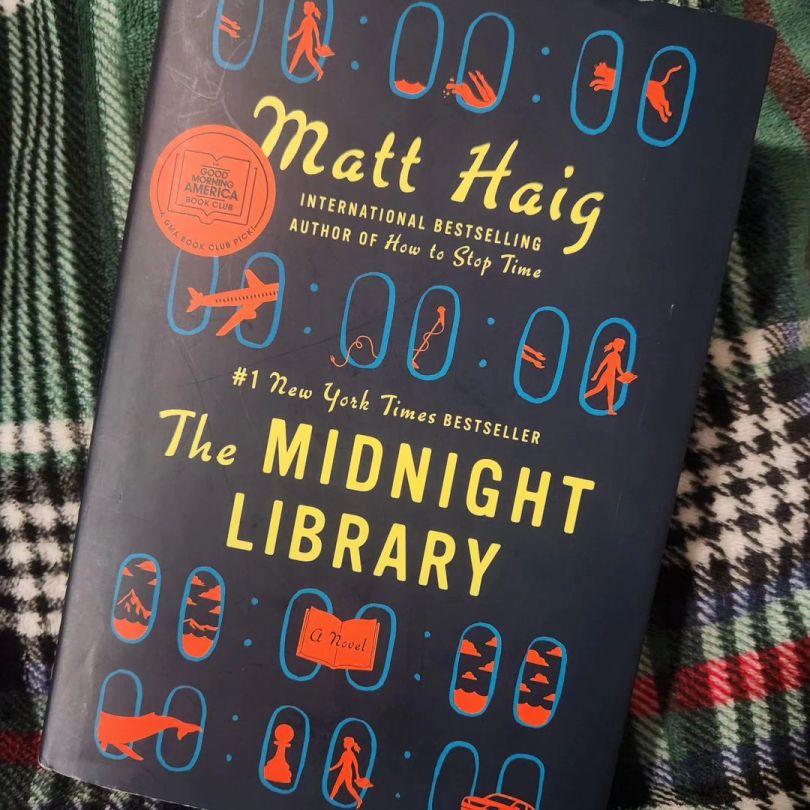
“What is the best way to live?” If you suddenly find yourself between life and death and are given the chance to revisit every past decision you’ve made, right the wrongs, and relive an alternative, better future for yourself, would you take it? In The Midnight Library by Matt Haig, Nora Seed receives a once-in-a-lifetime opportunity to do just that.
Plot Summary
Nora Seed isn’t having a great day; within 24 hours, her cat dies, and she loses her job. She feels like she doesn’t have anyone left in her life: Her parents passed years ago, she ended things with her fiancé, and she hasn’t spoken to her brother or best friend in what seems like forever. Her only piano student stopped taking lessons from her, and her older neighbor admits he no longer needs her help picking up his medications for him. This unfortunate state of affairs weighs heavily on Nora’s heart — to the point that she decides to attempt suicide.
However, unexpectedly, she wakes up in front of a large library that is maintained by her old high school librarian, Mrs. Elm. But this isn’t an ordinary library; as Mrs. Elm eventually explains, every book inside contains a variation of Nora’s life. Guided by a specific book that details all of her regrets, Nora has the option to pick any of them to see what her life would have been like if she made different choices. If, for any given moment, she starts to feel disappointment in the alternative reality, she’s immediately brought back to the library to choose again. However, if she finds a life that she’s completely happy with, it will eventually overwrite her root life. But all of this can only happen as long as the clock is stuck at midnight.
From there, Nora explores a variety of realities: one where she decides to marry her fiancé, others where she becomes an Olympic swimmer, a glaciologist, or a successful rock star. But she still struggles to find happiness. Eventually, Nora learns that these are all lives where she pursues other people’s dreams and not her own and that her root life’s actions, no matter how small, actually made a positive difference in the people around her.
By the time she comes to this conclusion, the library is already starting to fall apart; Nora is running out of time. But as the seconds begin to pass again, she finally realizes that she wants to live after all.
Why I Picked Up the Book
If you’re going to use a giant library as a metaphor for life, you’ve already won me over. The idea that each book represents another reality was an intriguing concept for me. Also, I really enjoyed Blake Crouch’s Dark Matter, so the idea of parallel universes made this even more appealing as a TBR pick.
Why I Set the Book Down
There were a few reasons why I wanted to put the book down:
- I really tried to empathize with Nora, but she didn’t feel like a realistic or believable character.
- While I appreciated the library metaphor, I was a little disappointed that it wasn’t used other than as a vehicle for transporting Nora between lives. I think that there was more potential there.
- After a certain point, things started to get a little fluffy and repetitive, which made it harder to push through to the end.
Why I Picked the Book Back Up
Although I already had a feeling about how the book would end early on in the story, I was curious about how that would be achieved and the type of character development Nora would display once she came back from the brink of death. The novel is also a pretty quick read and on the shorter end, so it’s pretty easy to get through in one weekend.
Final Thoughts
Would I read the book again? Probably not, but I will say it’s worth trying at least once. It’s definitely not what I would consider a “bad” book; it actually has a few good things going for it that I genuinely think other readers might enjoy. However, it’s just not for me.
 Aries Payne